
2026-08-21 · Carlos Mendoza
Military PCS Move-Out: Handling Water Damage in Base Housing Before Inspection
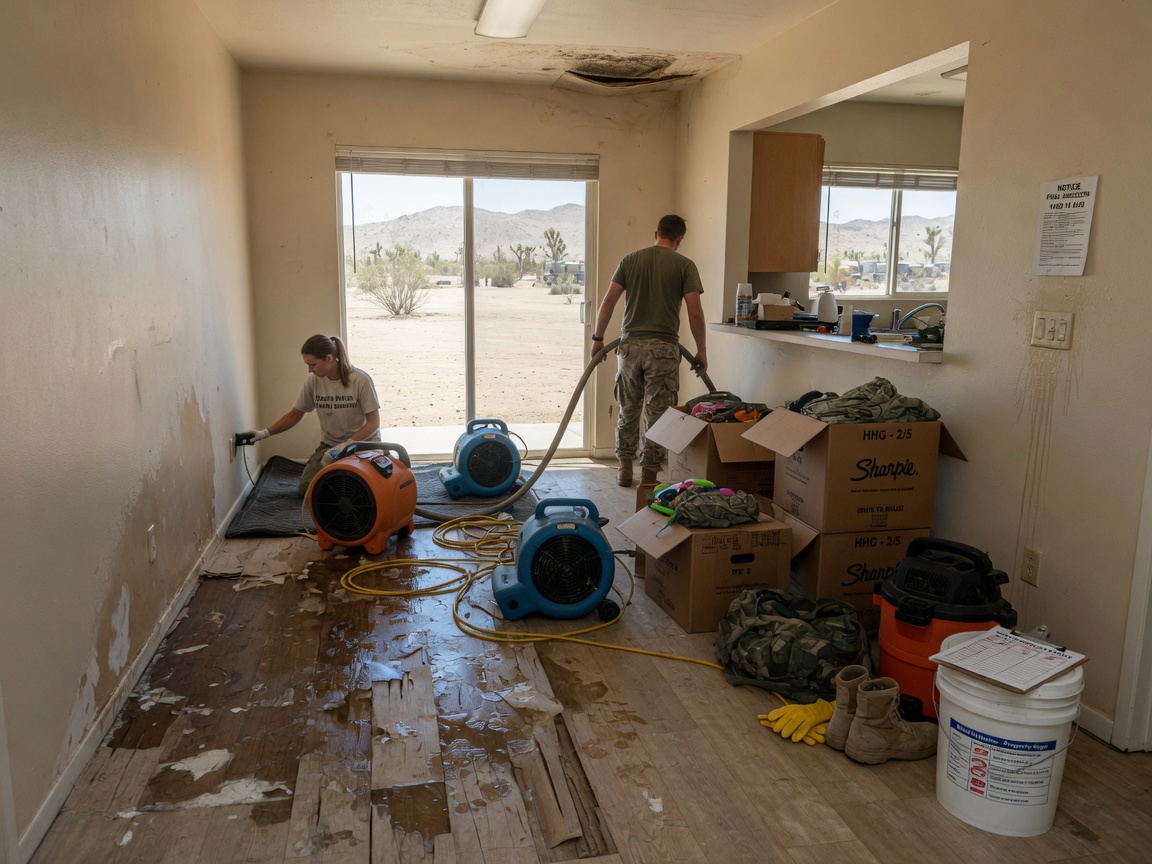
You are inside your PCS window, boxes are half packed, and you have just found a stain on a ceiling, a soft patch of flooring, or a musty smell under a sink. This is a genuinely common situation and it is usually more manageable than it feels at 11pm with a report date closing in.
The most important thing to understand up front: what usually determines whether damage gets charged to you is not the damage itself, it is whether and when you reported it.
Report It. Do Not Quietly Fix It.
The instinct is to handle it yourself before anyone notices. That instinct costs people money.
Broadly, damage arising from a maintenance failure — a pipe that corroded and failed, a roof that leaked, an appliance the housing office supplied that died — is the landlord's responsibility. Damage arising from tenant negligence — an overflowing tub, a hose you left running, or a leak you knew about and did not report while it got worse — can be charged to you.
That second category is where reporting matters. A pipe that failed inside a wall is not your fault. A pipe that failed inside a wall six weeks ago, which you noticed and said nothing about while the subfloor rotted, starts to look different. Delay is what shifts liability, and an unreported problem discovered at final inspection is the worst version of this.
There is also a practical angle: once it is reported, there is a dated record that the damage existed and was raised, which protects you regardless of who ends up responsible for the repair.
So: submit a maintenance request in writing, through whatever system your housing office uses, as soon as you find it. Keep the ticket number. If you report by phone, follow up with an email so there is a written trail.
Document It Before You Touch Anything
Before you move furniture, lift carpet or wipe anything down:
- Wide photos of the room from several angles
- Close-ups of the stain, the soft flooring, the warped baseboard, the discolouration
- A shot that shows the scale — how high up the wall, how large an area
- Video walking through, narrating what you are seeing
- The date and time you discovered it, written down
Photograph the contents that got wet too. If your own belongings were damaged, that is a renter's insurance matter rather than a housing office one, and the same photographs serve both.
Keep a log of every conversation: who you spoke to, when, and what was said.
Do Not Hide It
Worth saying plainly, because people do try it under deadline pressure. Do not paint over a water stain, caulk over a soft spot, or cover discolouration with furniture before an inspection.
Inspectors know exactly what fresh paint on one ceiling patch means. Moisture meters read straight through paint. And concealed damage that surfaces later is treated far more harshly than the same damage reported honestly — it moves the conversation from a maintenance issue to a disclosure issue.
This applies with particular force to anything that looks like mold. Mold in military housing has been the subject of congressional attention and litigation, and housing partners take it seriously. Covering it up is the worst available option.
Know Your Rights as a Tenant
If you are in privatized military family housing, which covers most Army installations, the Military Housing Privatization Initiative Tenant Bill of Rights applies to you. Among other things it establishes your right to report maintenance issues and have them addressed, your right to access the maintenance history of your home, and a formal dispute resolution process if you and the housing partner disagree about responsibility for damage or charges.
That last point is the one most people do not know exists. If you are told at final inspection that you are being charged for damage you believe was a maintenance failure, you are not simply stuck with it. Ask your housing office about the dispute resolution process in writing, and involve your installation's Military Housing Office or tenant advocate, which is a separate body from the private housing partner.
Requesting the maintenance history for your unit is often decisive. If the same pipe or the same ceiling has been repaired twice before you moved in, that is highly relevant to whose problem this is.
Getting It Actually Dry, Not Just Dry-Looking
Whoever ends up paying, the drying has to be done properly, and this is where High Desert conditions mislead people.
The air out here is dry enough that a wall will feel completely dry to the hand while the cavity behind it is still saturated. Surface moisture evaporates fast; water trapped inside an assembly does not. A fan pointed at a stain for two days produces something that looks fine and reads wet on a meter.
This matters at inspection because inspectors use moisture meters. It matters more because trapped moisture is what produces mold three weeks after you have cleared the unit and moved to your next duty station — at which point you are several states away trying to resolve it remotely.
Proper drying means extracting water from the pad and subfloor, mapping where the water actually travelled with meters and thermal imaging, opening the assembly where water is sealed inside, and running air movers and commercial dehumidifiers with readings taken daily at fixed points until the numbers come back to normal. Typically three to five days.
See structural drying services and military housing water damage for what that involves.
The Documentation That Closes It Out
This is the part that actually protects you at inspection: moisture readings, photographs and daily drying logs.
A written record showing the moisture readings when work started, the readings each day, and the final readings when equipment came out is the difference between "we dried it, honest" and a document you can hand an inspector. If a housing office or a future dispute needs evidence that the unit was returned dry, that is the evidence.
Ask for it in writing, and keep a copy for yourself rather than only handing it over.
If You Are Short on Time
Tell us your inspection date when you call. We answer 24 hours a day, which matters when you are working around a report date and a packing schedule, and we will be straight with you about what is achievable before that date rather than committing to something that is not.
If the timeline genuinely does not work, say so to your housing office early rather than late. A documented in-progress remediation with a drying log is a far better position at inspection than an unreported problem or a rushed cover-up.
Before You Hand Over the Keys
A quick sweep of the places water damage hides in base housing:
- Under every sink — look for swelling at the cabinet base and staining at the back
- Behind and under the washing machine and around the water heater
- Around toilet bases — soft or discoloured flooring
- Ceilings below upstairs bathrooms
- Along the bottom of walls in rooms on the same wall as plumbing
- Inside closets on exterior walls, where musty smell shows up first
- Around evaporative cooler ducting if the unit has one
Catching something a week before inspection is a manageable problem. Catching it on the day is not.
The Short Version
- Report it in writing immediately and keep the ticket number.
- Photograph everything before you touch it, with dates.
- Never paint over or conceal it.
- Ask for your unit's maintenance history if responsibility is disputed.
- Dry it properly with meter readings, not just a fan.
- Keep the drying documentation and hand a copy to the inspector.
- Know that a dispute resolution process exists under the Tenant Bill of Rights.
Related reading: the first 24 hours after a burst pipe and how fast mold spreads after water damage.