
2026-08-21 · Carlos Mendoza
Water Damage After Mojave Desert Flash Floods: What Homeowners Need to Know
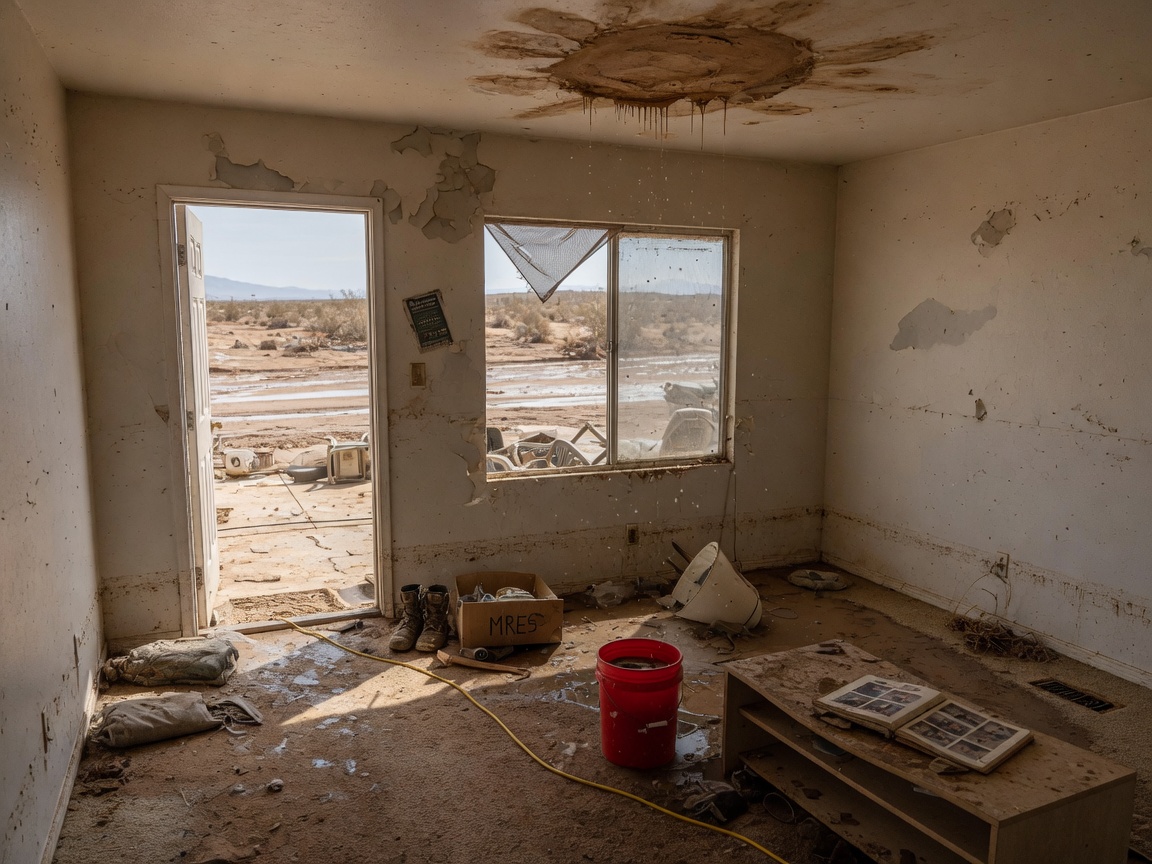
Flash flooding is the most misunderstood water damage event in the Mojave. People treat it like a big version of a burst pipe. It is not. The water is contaminated, and your standard homeowners policy almost certainly does not cover it. Both of those change what happens next.
First, the Part That Actually Kills People
Before any of the property discussion: do not drive into flooded roads or washes.
Most flash flood deaths happen in vehicles. Roughly twelve inches of moving water can float a car, and around six inches is enough to knock an adult off their feet. Desert flood water is opaque with sediment, so you cannot see that the road underneath has been scoured away — which happens routinely at wash crossings out here.
Turn around and find another route. A flooded dip in the road on a High Desert highway is not worth it, and the water often drops within an hour or two.
The other thing people underestimate: it does not need to be raining where you are. A storm cell over the mountains can send a wall of water down a wash into bright sunshine miles away. Dry washes are dangerous precisely because they look like safe, flat ground.
Why Desert Ground Floods So Fast
It seems backwards that the driest places flood the hardest, but the mechanism is simple.
Mojave soil is hardpan, often with a caliche layer, baked by months of sun. It absorbs very little water. Rain that would soak into soil elsewhere sheets across the surface here almost immediately, gathering into washes and low ground and arriving somewhere else at speed. Sparse vegetation means nothing slows it down.
Monsoon storms, typically July through September, deliver a lot of rain in a very short time, which is the worst possible combination with ground that cannot absorb it. Winter storms cause flooding differently, soaking already-saturated flat ground until it pools.
Burn scars make it dramatically worse. Ground stripped by wildfire sheds water and debris far faster than intact terrain, and the elevated risk persists for years after the fire. If there has been a fire upslope of you, your flood risk changed even though your property did not.
The Water Is Contaminated. This Changes Everything.
Water that has crossed open ground before entering your house is Category 3 — black water. It has picked up whatever it ran over: soil and sediment, animal waste, road oil and fuel residue, agricultural runoff, refuse, and frequently sewage where systems have surcharged or septic leach fields have been overwhelmed.
That classification governs what can be saved. With clean water from a burst pipe, the goal is drying materials in place. With flood water, porous materials that absorbed it come out and are disposed of:
- Carpet and carpet pad
- Drywall that wicked it up, usually cut back above the water line
- Insulation — always, it holds contaminated water and never reliably dries
- Particleboard and MDF cabinetry and furniture
- Upholstered furniture and mattresses that got wet
Hard, non-porous surfaces — concrete, tile, framing lumber, sealed hardwood — can generally be cleaned, treated and dried.
Do not try to clean it up yourself. Mopping contaminated water and carrying it through the house spreads it into rooms that were fine. Keep children and pets out entirely. Wear boots and gloves if you have to be in it at all, and wash thoroughly afterward. Our sewage backup cleanup page covers how contaminated water work differs.
The Sediment Problem
Something specific to desert flooding: the water brings the desert in with it. Fine silt and sand settle into carpet pad, under flooring, inside wall cavities and into HVAC returns and ductwork.
That sediment has to be physically removed before drying, not dried in place. Silt holds moisture against the structure, and a wall cavity with mud in the bottom will keep feeding damp upward for months no matter how long you run equipment. It also means ductwork frequently needs inspecting and cleaning after a flood, which people skip and then wonder about the smell.
Your Insurance Probably Does Not Cover This
This is the one that catches people, so it is worth being blunt.
Standard homeowners policies in California generally exclude flood — meaning surface water entering from outside — entirely. Not partially. Entirely. A burst pipe inside your wall is usually covered; the same volume of water arriving under your garage door from a wash is usually not.
Covering that requires separate flood insurance, through the NFIP or a private flood policy. NFIP policies typically carry a 30-day waiting period, so it cannot be bought when a storm is in the forecast.
Two things worth knowing:
- You do not have to be in a mapped high-risk flood zone to buy flood insurance or to flood. Plenty of Mojave flooding happens well outside mapped zones, because local washes and drainage are not always reflected in the mapping.
- Sewer and drain backup during a storm is a separate question again, usually needing its own endorsement on your homeowners policy.
If you are in a low-lying spot, near a wash, or downslope of a burn scar anywhere in the High Desert, Antelope Valley or Morongo Basin, this is worth sorting out in the dry season rather than discovering during one. See water damage insurance claims 101.
What to Do After the Water Drops
- Do not re-enter until it is safe. Watch for undermined foundations, and treat anything electrical as live until you know otherwise. If water reached outlets, appliances or your panel, get power cut before entering.
- Photograph everything before you move or remove anything — wide shots, close-ups, a clear record of how high the water reached. You will need this whether you are claiming on flood insurance or applying for disaster assistance.
- Do not start hauling things out yourself. Document first, and let contaminated material be handled with the right protection.
- Call for extraction promptly. Mold begins within 24 to 48 hours, and contaminated water accelerates the whole problem.
- Check whether your area has a disaster declaration, which can open up assistance routes that are not available otherwise.
Reducing the Damage Next Time
You cannot stop a flash flood, but you can change where the water goes:
- Know whether a wash runs near your property and where its overflow path is
- Keep drainage swales, culverts and yard grading clear of debris before monsoon season
- Grade soil to fall away from the foundation
- Sandbags placed before a storm work; placed after it starts, they mostly do not
- Raise anything valuable stored in garages and outbuildings off the slab — shelving rather than boxes on concrete
- Weather seals on garage doors and thresholds help with shallow sheet flow, which is the most common form of entry
The Short Version
- Never drive into a flooded road or wash — this is the part that kills people.
- Flash flood water is contaminated; porous materials that absorbed it come out.
- Do not clean it up yourself or let children and pets into it.
- Sediment has to be removed, not dried in place.
- Standard homeowners insurance almost certainly does not cover it; flood insurance has a 30-day wait.
- Photograph everything before moving anything.
If flood water has been in your property, call at any hour — our line is answered 24/7 and contaminated water does not wait for business hours any more than a burst pipe does.