
2026-08-21 · Carlos Mendoza
How to Handle a Burst Pipe Emergency: First 24 Hours
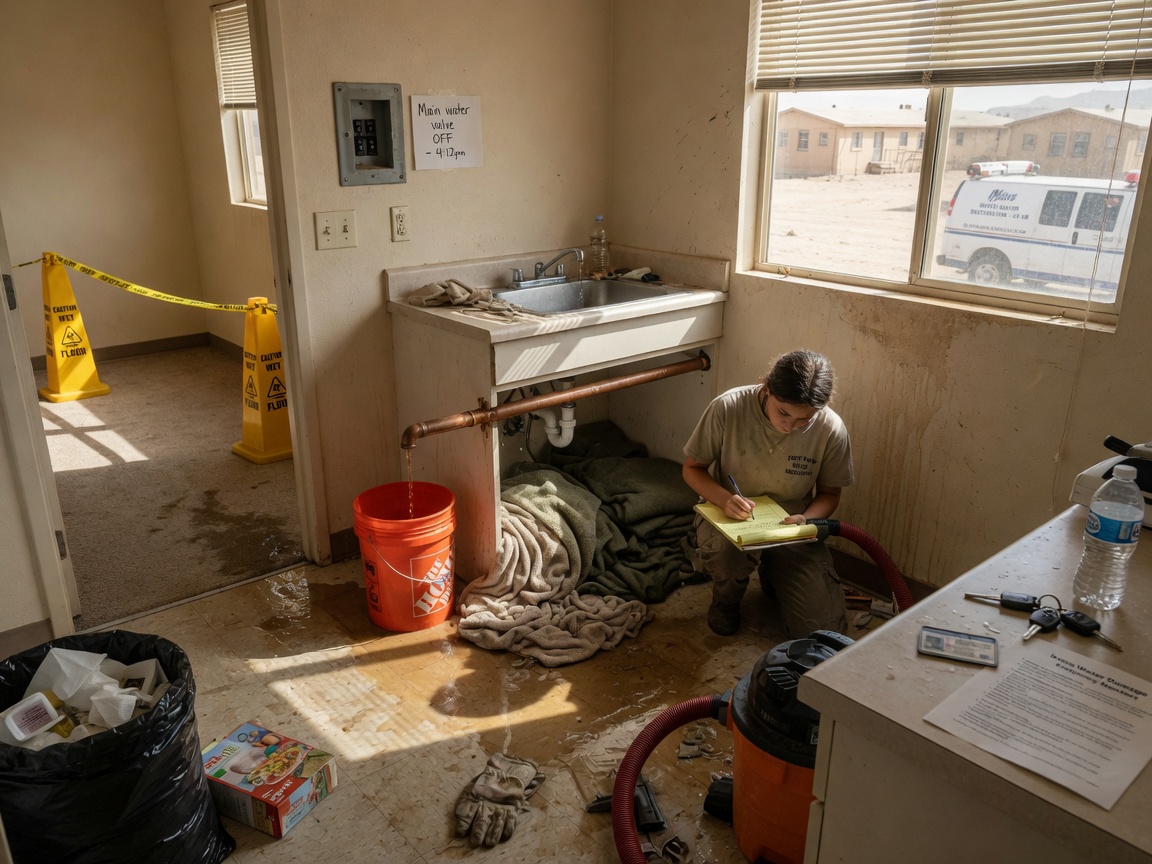
If a pipe has just burst, stop reading and go shut off your main water valve. Come back once it is off. Nothing else on this page matters as much as that.
Hour One: Stop the Water
Your main shutoff is usually where the supply enters the building — near the front hose bib, in the garage, in a utility closet, or at a meter box near the street. Turn it clockwise until it stops. If it is a lever, turn it a quarter turn so it sits across the pipe.
Once it is closed, open a faucet on the lowest level of the house. This drains the water still sitting in the pipes, which would otherwise keep feeding the break. Open a couple more on upper floors to let air in behind it.
A burst supply line under pressure puts out a genuinely large volume of water — often more in twenty minutes than most people expect to see in a whole flood. That is why the search for the valve is so expensive if you have not located it before. Worth doing this weekend: find yours, and check that it actually turns. Valves that have not moved in fifteen years seize, and discovering that at 2am with water coming through the ceiling is a bad time to find out.
Hour One: Safety Before Cleanup
Water and electricity are the thing that turns a property loss into an injury. Do not walk into standing water that is near outlets, appliances or a breaker panel. If you can reach your panel without stepping in water, cut power to the affected rooms. If you cannot reach it safely, leave it and stay out of the area.
Other things worth doing straight away:
- If the water is coming through a ceiling, get out from under it and put a bucket down from the side. Saturated drywall comes down suddenly and it is heavier than it looks.
- If the burst is near a water heater or gas appliance, and you smell gas, leave the building and call your gas utility from outside.
- Keep children and pets out of the area entirely.
Hours One to Three: Photograph Everything
Before you move a single thing, photograph it. This is the step people skip and regret.
Take wide shots of each affected room from several angles, then close-ups of the damage itself: the standing water, the wet flooring, the stained ceiling, the failed pipe or fitting if you can see it. Get a shot showing how high the water reached on the wall. Photograph the contents that got wet, including serial numbers on appliances and electronics.
Then write down the time you discovered it and the time you shut the water off. Adjusters ask, and "sometime Tuesday night" is worth far less to your claim than "discovered 1:40am, main closed 1:52am."
Keep everything you remove. Do not take soaked carpet to the tip before anyone has seen it.
Hours One to Six: Limit the Spread
Once it is safe and documented, you can start reducing the damage:
- Move what you can lift to a dry room — furniture, boxes, anything on the floor.
- Get furniture legs off wet flooring. Put aluminium foil, wooden blocks or plastic under them. Wooden furniture legs bleed stain into wet carpet within hours and it does not come out.
- Lift curtains and bedding skirts off the floor.
- Take up loose rugs, which will otherwise stain the floor underneath.
- Mop or towel standing water off hard surfaces if the water is clean.
A few things not to do. Do not use a household vacuum on standing water — it is not rated for it and you will destroy the vacuum, possibly with a shock. Do not put a box fan on the wet area yet if the water may be contaminated, because you will aerosolise it. And do not start pulling up flooring or cutting drywall on your own; where that needs doing, it needs doing where the meters say, not where it looks wet.
Hours Two to Twelve: Get a Crew In
This is the point where the outcome divides. Water wicks up drywall at roughly an inch an hour and travels along joists into rooms that look completely dry. Mold begins establishing on damp organic material within 24 to 48 hours. Everything you are trying to prevent happens inside the first day.
What a crew does that you cannot do with towels and a fan: extract the water trapped under the carpet pad and in the subfloor, find where the water actually went using moisture meters and thermal imaging, and dry the structure with air movers and commercial dehumidifiers that remove moisture from the room rather than just blowing it around. Household fans move air across a surface; they do not take water out of a building.
Our line is answered 24 hours a day, so there is no reason to sit with it until morning. See burst pipe emergency cleanup and 24/7 emergency water extraction for what that involves.
A Note on Frozen Pipes
If the burst followed a hard freeze, there is something specific you should know: a pipe often splits while frozen but stays sealed by the ice. Nothing leaks during the cold snap. The flooding starts at thaw, which is typically mid-morning, frequently after everyone has left for work.
So if you have had a freeze and suspect a pipe froze, shut the main off before things warm up rather than waiting to see what happens. Open a faucet to relieve pressure in the line. And never thaw a pipe with an open flame — a heat gun on low or a hair dryer, working from the faucet end backwards, is the safe way.
This matters across the High Desert and Antelope Valley, where overnight lows drop well below freezing through winter. Our guide to preventing frozen pipe bursts covers what to do before the first cold night.
Hours Twelve to Twenty-Four: Start the Claim
Call your insurer as soon as it is a reasonable hour — most have 24-hour claim lines, so you can often do it immediately. Sudden and accidental damage, which is what a burst pipe normally is, is commonly covered. Gradual seepage and long-term neglect usually are not.
Have ready: when you found it, when you shut off the water, what you think caused it, and your photographs. Ask specifically whether your policy covers the damage only or also the repair to the pipe itself — those are frequently treated differently.
The documentation a restoration crew produces as they work, being moisture readings, photographs and daily drying logs, is exactly what an adjuster wants to see. It is often the difference between a claim that moves and one that stalls.
What Happens Next
Extraction is usually finished on the first visit. Drying typically runs three to five days with equipment in place and readings taken daily at the same points, and it should continue until the numbers say the structure is dry rather than until a set number of days has passed. Repairs follow after that.
For a fuller picture of the week ahead, see the water damage restoration timeline.
The Short Version
- Shut off the main. Open a low faucet.
- Stay out of water near electrics. Cut power to affected rooms if you can do it safely.
- Photograph everything before you move it. Note the times.
- Move what you can. Get furniture legs off wet flooring.
- Call for extraction — do not wait for morning.
- Call your insurer and start the claim.
If you are in the middle of one right now, call us. The line is answered at any hour, and we will talk you through the shutoff before anyone is even on the road.